
Qualified Dividends and Capital Gain Tax Worksheet 2026
For the 2026 tax year (returns filed in 2027). Last updated [date] · Written and Reviewed by Rehan Usmani | MBA, EA
The Qualified Dividends and Capital Gains Tax Worksheet figures your tax when you have qualified dividends or long-term capital gains. It taxes those dollars at 0%, 15%, or 20% instead of your regular rate. For 2026, the 0% rate covers taxable income up to $49,450 if you’re single, $98,900 if you’re married filing jointly, and $66,200 if you’re head of household. This guide walks you through every line.
You need this worksheet if you file Form 1040 and have qualified dividends (line 3a) or a net capital gain. Tax software fills it in for you. Doing it by hand lets you check line 16 and plan your sales before year-end.
Need a hand with your return? Tax preparation is what we do every day at Black Ink Tax and Accounting Services.
2026 Long-Term Capital Gains Tax Rates
Your rate depends on your total taxable income (Form 1040, line 15). It doesn't depend solely on how big the gain is. Here are the 2026 thresholds from IRS Rev. Proc. 2025-32 .
| Filing Status | 0% Rate Up To | 15% Rate Up To | 20% Rate Above |
|---|---|---|---|
| Single | $49,450 | $545,500 | $545,500 |
| Married Filing Jointly / Qualifying Surviving Spouse | $98,900 | $613,700 | $613,700 |
| Married Filing Separately | $49,450 | $306,850 | $306,850 |
| Head of Household | $66,200 | $579,600 | $579,600 |
| Estates and Trusts | $3,300 | $16,250 | $16,250 |
Note: These numbers go on worksheet line 6 (the 0% ceiling) and line 13 (the 15% ceiling).
What Changed From 2025
The thresholds rose about 2.3% over 2025. A single filer’s 0% ceiling moved from $48,350 to $49,450. A joint filer’s ceiling moved from $96,700 to $98,900.
The standard deduction went up too: $16,100 for single or married filing separately, $32,200 for married filing jointly, and $24,150 for head of household. Schedule 1-A deductions, including the enhanced senior deduction of up to $6,000 per eligible person, can lower your taxable income further. That can pull more of your gain into the 0% band.
Want last year’s numbers? See our 2025 qualified dividends and capital gain tax worksheet guide.
What the Qualified Dividends and Capital Gain Tax Worksheet Does
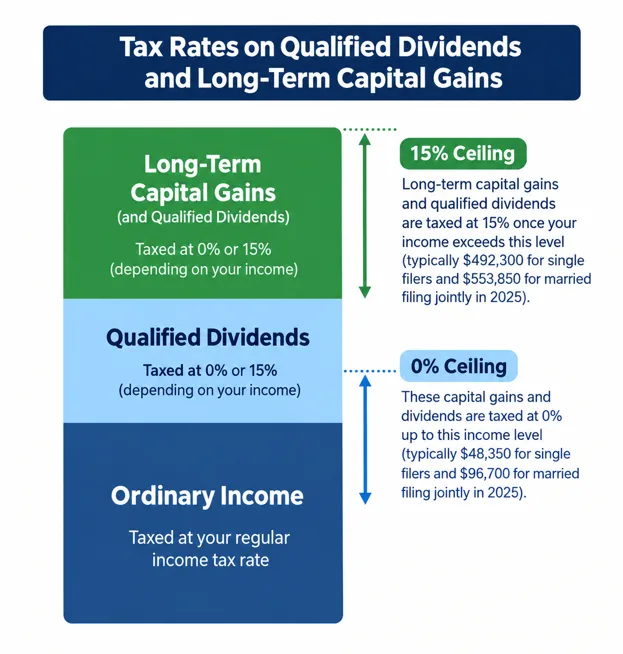
The worksheet stacks your income in layers. Your ordinary income fills the tax brackets first. Your qualified dividends and long-term gains sit on top of that pile.
Whatever part of the top layer lands under the 0% ceiling pays no tax. The next part pays 15%. Anything above the 15% ceiling pays 20%. The worksheet finds those three slices, taxes each one, and then compares the result to your regular tax. You pay the smaller number.
A few terms you need to understand:
- Qualified dividend: a dividend that meets the holding period and gets the lower rates. It shows up in box 1b of Form 1099-DIV.
- Net capital gain: your net long-term capital gain after subtracting any net short-term capital loss.
Taxable income: your income after the standard or itemized deduction and any Schedule 1-A deductions. It’s Form 1040, line 15.
Who Uses This Worksheet (and Who Uses the Schedule D Tax Worksheet Instead)
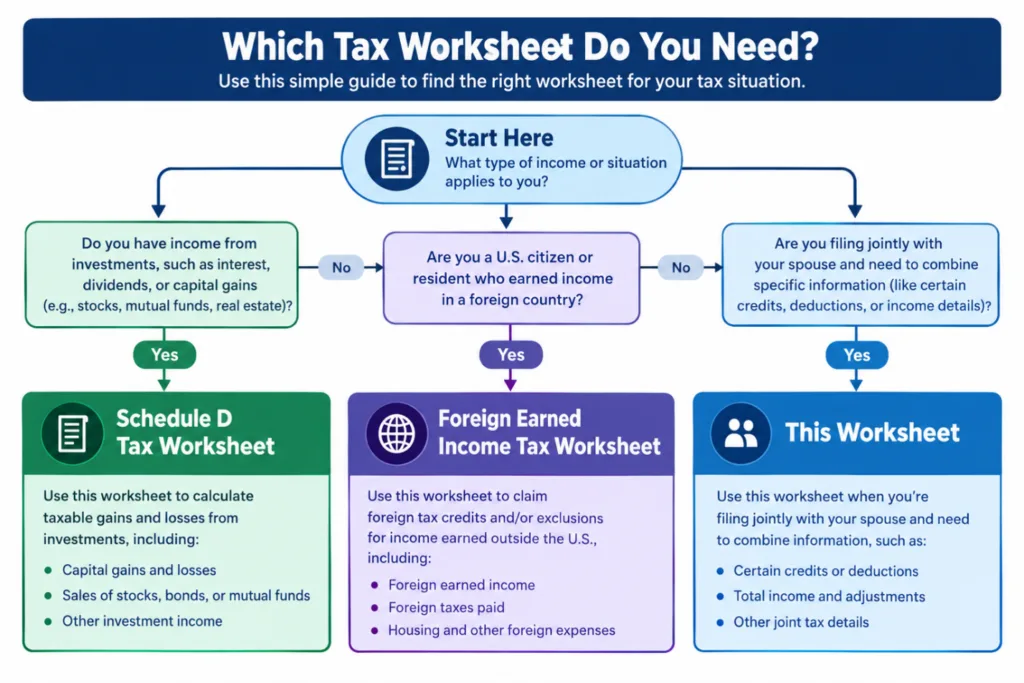
Use this worksheet if you have qualified dividends on Form 1040, line 3a, or a net capital gain.
Switch to a different worksheet in these cases:
- Schedule D Tax Worksheet: use it if Schedule D line 18 (28% rate gain) or line 19 (unrecaptured section 1250 gain) has an amount above zero. This worksheet can’t handle those gains.
- Foreign Earned Income Tax Worksheet: use it if you file Form 2555.
This is the mistake we see most on do-it-yourself returns. People with collectibles gains or real estate depreciation recapture use the wrong worksheet and get the wrong tax.
What You Need Before You Start
Gather these first:
- Form 1099-DIV: box 1b (qualified dividends) and box 2a (capital gain distributions)
- Form 1099-B or 1099-DA for your sales
- Form 8949 and Schedule D
- Form 1040, completed through line 15
You can’t start the worksheet until your taxable income on line 15 is final.
How to Fill Out the 2026 Worksheet, Line by Line
The line numbers below follow the 2025 Instructions for Form 1040, the latest final version. The 2026 thresholds go on lines 6 and 13. We’ll recheck every line when the IRS publishes the 2026 instructions.
Lines 1 to 5: Separate Ordinary Income From Preferential Income
These lines split your taxable income into two piles.
| Line | What to enter | 2026 note |
|---|---|---|
| 1 | Taxable income from Form 1040, line 15 | Includes all income, short-term gains too |
| 2 | Qualified dividends from Form 1040, line 3a | From 1099-DIV box 1b, if you met the holding period |
| 3 | The smaller of Schedule D line 15 or 16 (zero if either is a loss). No Schedule D? Use Form 1040, line 7a. | Net long-term gain only |
| 4 | Line 2 plus line 3 | Total income eligible for the 0%, 15% and 20% rates |
| 5 | Line 1 minus line 4 (not below zero) | Your ordinary income |
Lines 6 to 9: The 0% Slice
Line 6 is the 0% ceiling for your filing status: $49,450 single or married filing separately, $98,900 married filing jointly or qualifying surviving spouse, or $66,200 head of household.
| Line | What to enter |
|---|---|
| 6 | Your 0% ceiling |
| 7 | The smaller of line 1 or line 6 |
| 8 | The smaller of line 5 or line 7 |
| 9 | Line 7 minus line 8. This is the amount taxed at 0%. |
Lines 10 to 17: The 15% Slice
Line 13 is the 15% ceiling: $545,500 single, $306,850 married filing separately, $613,700 married filing jointly or qualifying surviving spouse, or $579,600 head of household.
| Line | What to enter |
|---|---|
| 10 | The smaller of line 1 or line 4 |
| 11 | The amount from line 9 |
| 12 | Line 10 minus line 11 |
| 13 | Your 15% ceiling |
| 14 | The smaller of line 1 or line 13 |
| 15 | Line 5 plus line 9 |
| 16 | Line 14 minus line 15 (not below zero) |
| 17 | The smaller of line 12 or line 16. This is the amount taxed at 15%. |
Lines 18 to 21: Tax at 15% and 20%
| Line | What to enter |
|---|---|
| 18 | Line 17 times 15% |
| 19 | Line 9 plus line 17 |
| 20 | Line 10 minus line 19. This is the amount taxed at 20%. |
| 21 | Line 20 times 20% |
Lines 22 to 25: Add Ordinary Tax and Compare
| Line | What to enter | 2026 note |
|---|---|---|
| 22 | Tax on the amount on line 5 | Use the Tax Table under $100,000. Use the Tax Computation Worksheet at $100,000 or more. |
| 23 | Line 18 plus line 21 plus line 22 | |
| 24 | Tax on the amount on line 1, same method as line 22 | The regular-rate tax, as a check |
| 25 | The smaller of line 23 or line 24 | Enter on Form 1040, line 16 |
Line 25 is your tax. It goes on Form 1040, line 16.
One caution on the examples below. We used the 2026 tax rate schedules to compute them. When your income is under $100,000, the IRS requires the Tax Table for lines 22 and 24. It can differ from the rate schedule by a few dollars.
2026 Worked Examples
These six examples cover every filing status and all three rates. Each one runs through the 25-line worksheet with 2026 thresholds. Your own numbers will differ, so treat the savings as a guide, not a promise.
Example 1: Single, $45,000 taxable income, $8,000 in qualified dividends and long-term gains
Your ordinary income is $37,000. That leaves $12,450 of room under the $49,450 ceiling, so all $8,000 is taxed at 0%. Worksheet tax (line 25): $4,192. Regular-rate tax would be $5,152, so you may save about $960.
Example 2: Single, $60,000 taxable income, $15,000 in gains and dividends
Your ordinary income is $45,000. That uses most of the 0% band, so only $4,450 gets 0%. The other $10,550 gets 15%. Worksheet tax: $6,734.50. You may save about $1,177.50.
Example 3: Married filing jointly, $110,000 taxable income, $40,000 in gains and dividends
Your ordinary income is $70,000, well under $98,900. So $28,900 is taxed at 0% and $11,100 at 15%. Worksheet tax: $9,569. You may save about $4,055.
Example 4: Head of household, $80,000 taxable income, $20,000 in gains and dividends
Your ordinary income is $60,000 against a $66,200 ceiling. So $6,200 is taxed at 0% and $13,800 at 15%. Worksheet tax: $8,916. You may save about $1,585.
Example 5: Married filing separately, $320,000 taxable income, $40,000 in gains and dividends
Your ordinary income is $280,000. The 15% ceiling is $306,850, so $26,850 is taxed at 15%. The other $13,150 is taxed at 20%. Worksheet tax: $73,426.75. You may save about $7,342.50.
Watch out: the 20% threshold for married filing separately is much lower than for single filers. Filing separately can push you into the top rate sooner.
Example 6: Single, $600,000 taxable income, $100,000 in gains and dividends
Your ordinary income is $500,000. The 15% band holds $45,500, and the remaining $54,500 is taxed at 20%. This return uses all three rates. Worksheet tax: $161,494.25. You may save about $17,275.
Note: the 3.8% net investment income tax would also apply here. The worksheet doesn’t include it.
Where to Find the Official 2026 Worksheet
The 2026 Form 1040 instructions aren’t out yet. When they publish, the worksheet will sit in the line 16 instructions. Until then, you have two good sources:
- The latest final version, the 2025 Instructions for Form 1040, which shows the same line structure.
- IRS Publication 505 (2026), which has Worksheet 2-7 (the Qualified Dividends and Capital Gain Tax Worksheet for the 2026 Estimated Tax Worksheet, line 4) and Worksheet 2-10 (the annualized version). Use these to size your estimated payments now.
We built a printable version, too. Download the 2026 worksheet PDF with lines 6 and 13 already filled in for every filing status.

Using the Worksheet for 2026 Year-End Tax Planning
This worksheet figures one thing: your regular income tax on qualified dividends and long-term gains. It leaves out:
- Net investment income tax (NIIT). This 3.8% tax is figured on Form 8960. It starts above modified AGI of $200,000 single or head of household, $250,000 joint, and $125,000 married filing separately. These amounts aren’t indexed for inflation.
- State income tax. New York taxes capital gains as ordinary income.
- Alternative minimum tax (AMT).
The 25% and 28% rates. Unrecaptured section 1250 gain is taxed at a maximum of 25%. Collectibles gain and the taxable part of section 1202 gain are taxed at a maximum of 28%. Use the Schedule D Tax Worksheet for both.
What the Worksheet Does Not Cover
This worksheet figures one thing: your regular income tax on qualified dividends and long-term gains. It leaves out:
- Net investment income tax (NIIT). This 3.8% tax is figured on Form 8960. It starts above modified AGI of $200,000 single or head of household, $250,000 joint, and $125,000 married filing separately. These amounts aren’t indexed for inflation.
- State income tax. New York taxes capital gains as ordinary income.
- Alternative minimum tax (AMT).
- The 25% and 28% rates. Unrecaptured section 1250 gain is taxed at a maximum of 25%. Collectibles gain and the taxable part of section 1202 gain are taxed at a maximum of 28%. Use the Schedule D Tax Worksheet for both.
Common Mistakes to Avoid
- Testing the gain instead of taxable income. The 0% rate depends on your total taxable income, not on the size of the gain.
- Counting nonqualified dividends. Only the amount in box 1b qualifies. Box 1a includes ordinary dividends that don’t.
- Missing the holding period. You must hold the stock for more than 60 days during the 121-day period that starts 60 days before the ex-dividend date.
- Using last year’s thresholds. The 2025 numbers are lower. Use the 2026 table above.
- Skipping loss carryovers. Unused capital losses from prior years reduce your net gain. Check last year’s Schedule D.
- Using this worksheet when Schedule D line 18 or 19 has an amount. Those returns need the Schedule D Tax Worksheet.
Sources
- IRS Rev. Proc. 2025-32: 2026 capital gains thresholds, tax brackets, and standard deduction
- IRS Publication 505 (2026): Worksheets 2-7 and 2-10, senior deduction, NIIT
- 2025 Instructions for Form 1040: line 7a, line 3a holding period and the line 16 worksheet
- IRS Topic 409, Capital gains and losses: 25% and 28% rates and the loss limit
- Schedule D instructions (IRS.gov)
Reviewed by [CPA/EA name, credential] on [date]. This article is general information, not tax advice for your situation. Your numbers may differ, so talk to a tax professional before you act.
Ready to Get Your Taxes Right?
Capital gains and dividends are easy to get wrong, and the cost of a mistake lands on your return. Let’s make tax season the least stressful part of your year. Book a free consultation with Black Ink Tax and Accounting Services, and we’ll run your 2026 numbers with you.
Qualified Dividends and Capital Gain Tax Worksheet FAQs
It's $49,450 for single filers and married filing separately, $98,900 for married filing jointly, and $66,200 for head of household. These amounts are measured against your taxable income.
Taxable income. That's Form 1040, line 15, after your standard or itemized deduction and any Schedule 1-A deductions.
It will be in the Form 1040 instructions for line 16 once the 2026 edition is out. For planning now, use Pub. 505 (2026) Worksheet 2-7.
Use it when Schedule D line 18 (28% rate gain) or line 19 (unrecaptured section 1250 gain) has an amount. Then this worksheet doesn't apply.
No. Short-term gains count toward your taxable income, but you pay ordinary rates on them. They flow through Form 8949 and Schedule D into line 1 of the worksheet.
Yes. They get the same 0%, 15% and 20% rates. The worksheet combines them on line 4.
More than 60 days during the 121-day period that starts 60 days before the ex-dividend date. The date you bought and the date you sold both matter.
No. You figure NIIT on Form 8960. It starts above modified AGI of $200,000 single, $250,000 joint, and $125,000 married filing separately.
Indirectly, yes. These Schedule 1-A deductions lower your taxable income. A lower taxable income can move more of your gain into the 0% band.
The software fills it in for you. Knowing the worksheet helps you check line 16 and plan your sales before you make them.
For 2025, the 0% and 15% ceilings were $48,350 and $533,400 for single filers, and $96,700 and $600,050 for married filing jointly. See our 2025 worksheet guide for every status.
Yes. The IRS usually announces the new amounts in October or November. We'll update this page as soon as they're out.